
Friday Factoids: Can Drinking Soda Accelerate Aging?


A recurring story throughout news websites this week is a study about a link found between sugar-sweetened soda/pop and aging. The study published in the American Journal of Public Health found that individuals who drank pop frequently generally had shorter telomeres in their white blood cells than did individuals who did not drink as much pop. Telomeres are found at the end of chromosomes and are critical in cell division. The length of telomeres is believed to be linked to the health of the cell. Researchers believe that shorter telomeres indicate that an individual is less healthy and aging faster.


The study noted that telomere length did not appear to be affected by consumptions of diet pop or 100% fruit juices.  The study also reported that their results indicated 1 in 5 adults drink a 20-ounce pop daily and found that this consumption “could equal 4.6 years of extra aging.”


Simply put, this means that they found a link between sugar-sweetened pop and premature aging in some cells in the body, which, according to the article, puts individuals at risk for diabetes, heart disease, and stroke. This article compared the premature aging from drinking pop to that seen in individuals who smoke.


How much sugar is safe? The American Heart Association recommends limiting added sugar to no more than 150 calories a day for men and 100 calories a day for women (one 12-ounce can of regular pop has between 140-170 calories and about 40 grams of sugar).


Kimball, Henry. (2014, October). That sweet drink may age you. CNN Health.


Brittany Best, BA
WKPIC Doctoral Intern



Friday Factoids: Sleep Can Affect Brain Size!


A recent study examined the relationship between sleep and brain volume. The study, which was published in an online article from the journal Neurology, studied 147 adults. Two MRI scans were conducted on the participants 3 ½ years apart and the participants also completed a sleep hygiene questionnaire. The researchers determined that about 35% of the participants met criteria for “poor sleep health.”


For our neuro-folks, the study found a link between poor sleep quality and “reduced volume within the right superior frontal cortex in cross-sectional analyses” as well as “an increased rate of atrophy within widespread frontal, temporal, and parietal regions in longitudinal analyses.” Poor sleep did not appear to be correlated with hippocampal volume or atrophy.


If that sounds too complicated, read this! The study found a link between poor sleep quality and faster decline in brain volume or size (certain areas of the brain are more affected than others). They also found that the effects were more pronounced in individuals over 60 years old.


The study noted that it is unclear which comes first, so they don’t know if poor sleep causes the declining brain volume or if the declining brain volume causes poor sleep. However, these results may be an incentive to improve the quality of our sleep and to help our patients improve the quality of their sleep!


Sexton, C. E., Storsve, A. B., Walhovd, K., B., Johansen-Berg, H., Fjell, A. M. (2014). Poor sleep quality is associated with increased cortical atrophy in community-dwelling adults [Abstract]. Neurology, 83(11) 967-973.


Willingham, V. (2014, September). Lack of sleep may shrink your brain. CNN Health.


Brittany Best, BA
WKPIC Doctoral Intern


Friday Factoids: A Link Between TIA and PTSD?


A new study has investigated the link between “mini-strokes,” transient ischemic attacks (TIA’s) and the development of posttraumatic stress disorder (PTSD) symptoms. Published in the journal Stroke, the study examined 108 patients who had suffered a TIA. The study involved questionnaires the patients completed three months after their TIA. The co-author of the study Kathrin Utz, Ph.D. defined a TIA as a “brief episode of stroke-like symptoms, such as sudden onset of numbness, weakness or paralysis, slurred speech, loss of language, sudden loss of memory, blurred vision, confusion, and severe headache.” An article added that TIA are cause by a restricted blood supply and typically occur for less than 5 minutes.


The study found that 1/3 of the patients developed symptoms of PTSD, including worry, nightmares, flashbacks, and social isolation. The study also noted that individuals who exhibit symptoms of PTSD were also more likely to demonstrate symptoms of depression and anxiety. Utz reported that younger patients and patients who generally found it difficult to cope with stress were more likely to present with PTSD and other mental health symptoms. Although Utz stated that the reason for the correlation between TIA’s and PTSD symptoms is currently unclear, she suggested that an emphasis should be placed on teaching TIA patients, particularly, younger TIA patients, coping skills for managing stress.


Pedersen, Traci. (2014, September). Mini-stroke may lead to PTSDPsychCentral.


Brittany Best, BA
WKPIC Doctoral Intern



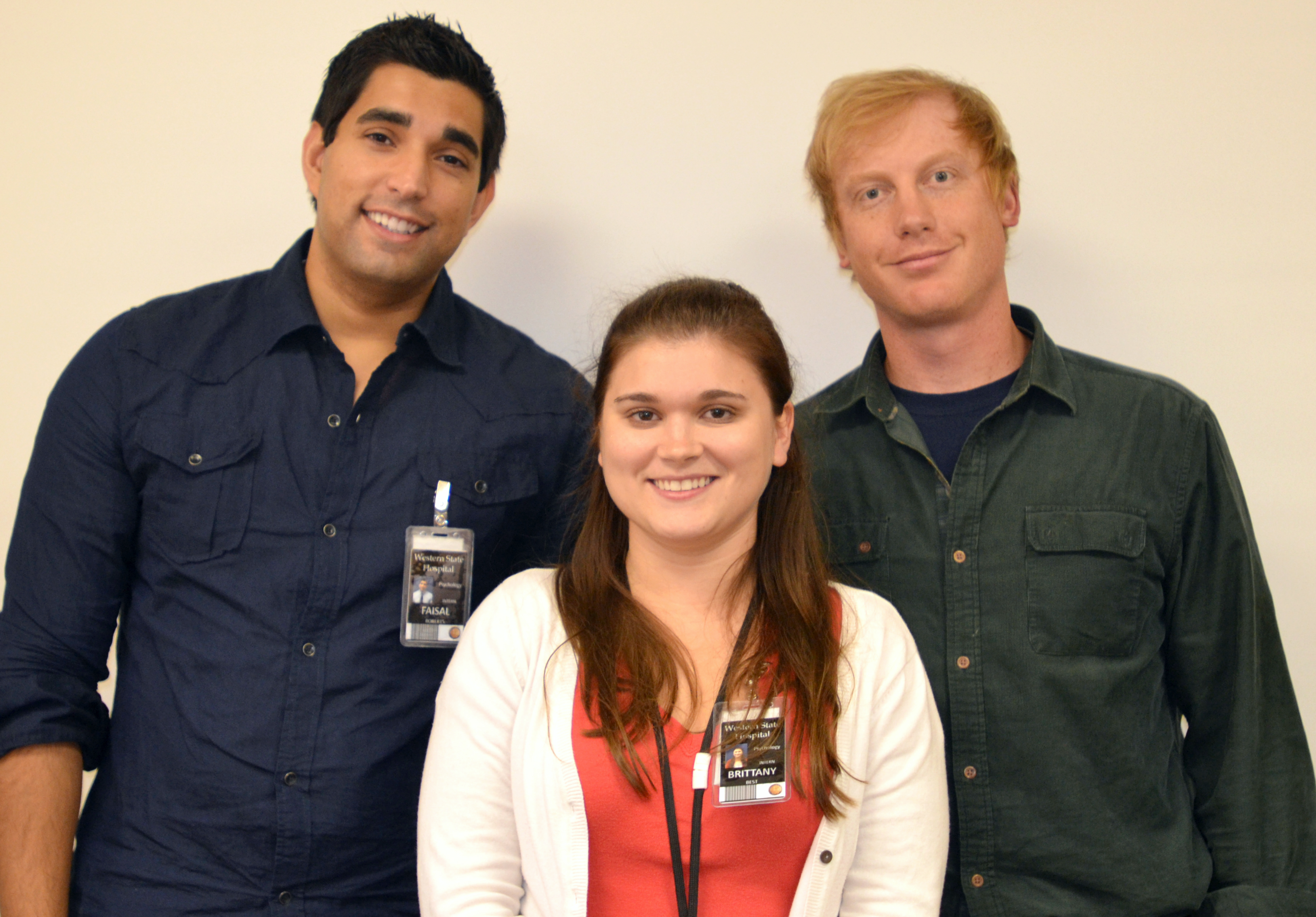
WKPIC INTERNS 2014-2015!

Wow has this group been camera-shy! But our intrepid photographer Will Battle at last tracked them down and got a photo.


On the left is Faisal Roberts from Carlow University in Pittsburgh, PA. At the center is Brittany Best, from the Adler School of Professional Psychology in Chicago, IL. On the right, we have Graham Martin, from the Chicago School of Professional Psychology in Chicago, IL.


Welcome!


Friday Factoids: Bullying in the Workplace


Bullying. What do you think of when you hear that word? What age demographic immediately springs to the forefront of your mind? What specific behaviors and images does your mind immediately conjure?


Without being especially informed or at all learned about the topic, I would have guessed that bullying reaches its peak around elementary school, and progressively wanes as children become more mature going through middle and high school. That’s not to ludicrously state that bullying completely and magically dissolves in the teenage years, but rather a (speculative) statement that traditional bullying behaviors (name calling, hitting, etc.) are not as frequent or blatant as children progress past elementary school.


A new nationwide study conducted by CareerBuilder that polled 3, 400 full time employees in the private sector across many different industries yielded results indicating that nearly 33 % of individuals in the workforce experienced bullying and, startlingly, 20 % have left their job due to it. Rosemary Haefner, an HR representative, stated that “Bullying impacts workers of all backgrounds regardless of race, education, income, and level of authority within an organization.” Although workplace bullying tended to affect more women than men (34% to 22 %), both ratios were fairly high. Regarding ethnicity, the numbers of those that felt bullied were relatively even: 25 % Latino, 27 % African American, and 24 % Caucasian.


“Professional bullying” is difficult to tackle head on, as the metric defining this kind bullying is elusive, diffuse and ambiguous. It is not the relatively basic conceptualization of bullying that exists in the schoolyard, which generally existed within the parameters of simplicity. This type of bullying has evolved to become increasingly complex and insidiously adaptive. “Professional bullying” can be direct, such as belittling, intimidation, and open criticism in front of others, or more subtle, such as passive aggressiveness, being ignored or dismissed, or being excluded from projects, etc. What do you make of this information? Are you at all surprised? What steps can be taken to reduce professional bullying?


Dill, Catherine. (2014, September).  One in five workers have left their job because of bullying.  Retrieved from Forbes.


Faisal Roberts, MA
WKPIC Doctoral Intern