Friday Factoid: Optimism is Heart Healthy!


By now most people are aware, at least to some degree, of things that are good for your heart.  Exercise? Check. Oatmeal? Done. Salmon? Affirmative. Managing Stress effectively? Why of course! Now let’s throw in a healthy dose of optimism for good measure! Results yielded from a new study conducted by the University of Illinois are suggestive that optimism can lead to improved heart health.


Led by Dr. Rosalba Hernandez, a professor of social work, the study examined more than 5,100 adults between the ages of 45 and 84. The construct of cardiovascular health was calculated by assessing seven dimensions: blood pressure, body mass index, fasting plasma glucose and serum cholesterol levels, dietary intake, physical activity, and tobacco use. These are the current metrics used by to American Heart Association to assess heath health. Each of these seven dimensions were rated either zero, one, or two (denoting poor, intermediate, and ideal scores, respectively) with higher scores corresponding with healthier heart states. To evaluate level of optimism, the participants completed surveys measuring mental health, levels of optimism, and physical health. In their results, a correlation was found between the participants’ total health score and their levels of optimism.


So it looks like we now have another reason to maintain a healthy, optimistic outlook on life!


Nauert, R. (2015). Optimism is heart healthy. Psych Central. Retrieved on January 12, 2015.


Faisal Roberts, M.A.
WKPIC Doctoral Intern


Friday Factoid: Origin of New Year’s Resolutions

We are now a little past one week into the new year of 2015. Did you make a New Year’s Resolution? If so, how well have you done with keeping it? I have never personally made one, for reasons that I’m unsure of. I didn’t decide to never make them; I just haven’t for whatever reason. Thinking about all of this made me wonder about the origin of making resolutions. Where did this custom start? When beginning my search, I expected a myriad of contradicting answers with the specific origin being evasive and somewhat ambiguous. However, from the little research that I’ve conducted, the answer appears generally consistent amongst a few different sources.


Before New Year’s was celebrated in January, it was celebrated in what we now know as the month of March by the Babylonians nearly 4,000 years ago. This time period was chosen as the start of the New Year as it was the beginning of spring time when the leaves come back and the crops grow, hence why it was a logical choice for them (Blaire, 2006). The Babylonians made promises to their gods at the beginning of the year, with promises to repay their debts and return borrowed objects. The Romans changed New Year’s to January in 153 B.C. (Blaire, 2006), named after one of their gods, Janus, the two faced god that could look backward at the old year while simultaneously looking forward at the new year (Petro, 2015). As opposed to returning objects and repaying debts, their resolutions generally regarding treating each other better.  Today, New Year’s Resolutions can encompass a wide variety of areas, but with personal improvement being the center (Blaire, 2006; Petro, 2015). Common resolutions include those pertaining to fitness, finances, altruism, kindness, charity, volunteer work, career goals, reading habits, learning new skills, giving up vices, etc. 


What do you think of New Year’s Resolutions? Is it a great way to kick off the new year with a positive mentality? A pointless endeavor that leads people to feel bad when they invariably fail on their goals? Or somewhere in the middle? Either way, belated happy new years from all of us at WKPIC!


Blaire, Gary, R. (2006). The History of New Year’s Resolutions. As retrieved from: http://ezinearticles.com/?The-History-of-New-Years-Resolutions&id=245213


Petro, Bill. (2015). History of New Year’s Resolutions: Where Did They Begin?
As retrieved from: http://billpetro.com/history-of-new-years-resolutions


Faisal Roberts, MA
WKPIC Doctoral Intern


Friday Factoid Catch-Up! Diabetes in Midlife Linked to Cognitive Decline 20 Years Later


New research from the John Hopkins Bloomberg School of Public Health reveals informative and quite honestly startling data regarding the correlation between diabetes in midlife and cognitive decline in older age. There is a strong correlation between the declination of cognitive processes such as memory, word recall, and executive functioning and the progression of dementia. Results yielded from the research suggest that diabetes tends to age the mind five years faster than the normative effects of aging. For example a 60-year-old with diabetes experiences a similar amount of cognitive decline as a 65-year-old without diabetes.


This study, led by Dr. Elizabeth Selvin, is thought to be the longest running study of its kind as it followed a cross-section of adults as they aged. For the study, Dr. Selvin used data from the Atherosclerosis Risk in Communities Study (ARIC), which began in 1987 and contains a participant pool of 15, 792 adults from four different states. The participants were evaluated (including a cognitive evaluation) four times, approximately three years apart, beginning in 1987. The participants were then seen a fifth and final time between 2011 and 2013. The researchers found that the participants with poorly controlled diabetes experienced cognitive decline that was 19 % worse than expected for their age group.


This research emphasizes the importance of a healthy lifestyle as it can potentially prevent diabetes and, now evidently, dementia. The cost of dementia nationwide was estimated to be approximately 159 billion dollars in 2010. With the fact that people are living longer than ever before, the cost of dementia is estimated to increase by an additional 80 billion dollars within the next 25 years. Dr. Selvin states that even if we could delay dementia for a few years, it could have a huge impact on the population in terms of both quality of life and healthcare costs. With America experiencing its highest obesity rates for both children and adults, it does not bode well regarding the estimated future prevalence of dementia. However, if this information is proliferated and embraced, it may have the potential to motivate people into adopting a healthier lifestyle to avoid the tragic fate of dementia.


Johns Hopkins Bloomberg School of Public Health. (2014, December 1). Diabetes in midlife linked to significant cognitive decline 20 years later. ScienceDaily. Retrieved January 5, 2015.


Faisal Roberts, MA
WKPIC Doctoral Intern


Friday Factoid Catch-Up! What Exactly Is Boxing Day?


Have you heard of Boxing Day?


December 26th is a holiday celebrated in England and many other countries (including Canada, where I am from!). Today, Boxing Day is similar to the American Black Friday (which is not celebrated in Canada). On Boxing Day in Canada, stores open early with many sales and deals. Just like here in the United States, people flock to stores and malls in huge numbers. However, historically, Boxing Day served a different purpose.


Unfortunately, Boxing Day seems to have lost its meaning and even the historical significance of the day is only theories. Some say that Boxing Day began in England in the Middle Ages as the servants’ day off (because they were required to work on Christmas Day).


Even this theory has two endings, as some people say that the servants made boxed lunches for the employers to eat while the servants took the day off and others say that the employers gave the servants gift boxes. Another theory entirely is that churches placed boxes where parishioners gave coins and the coins were given to the poor on Boxing Day.


Lemm, Elaine. (2014). What is Boxing Day? Why is it called Boxing Day?


Brittany M. Best, M.A.
WKPIC Doctoral Intern

Happy New Year from WKPIC!

2015 Good Wishes


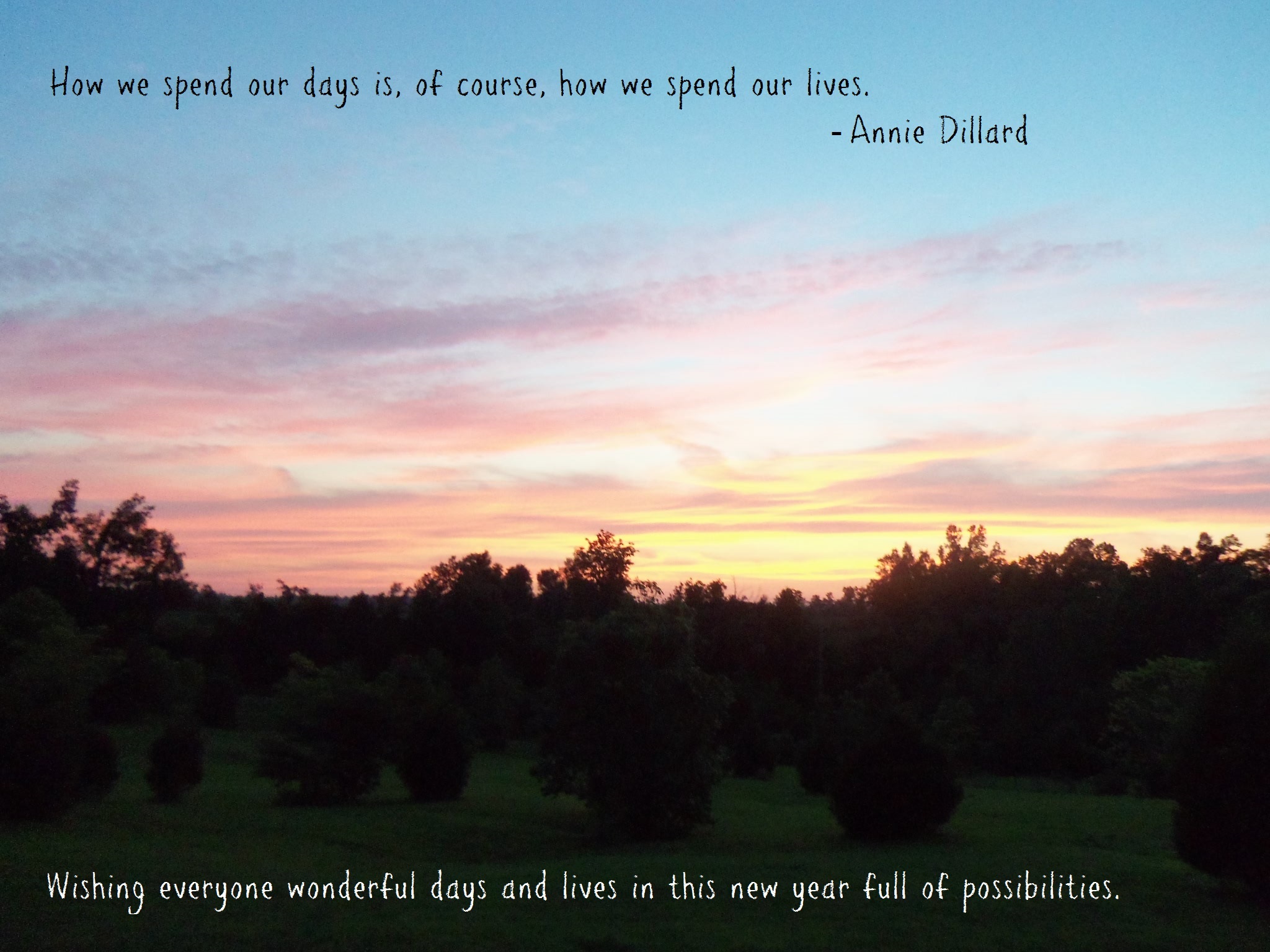
This is the view from my front porch in the spring and summer. As we head into the depths of winter, I’m sharing it, along with a favorite quote sent to me by dear friend, and wishing everyone reading this a fulfilling and wondrous 2015. For all the interns traveling for interviews, be safe, be confident, and be yourselves–and know that this is (and always has been) enough. You are the future of our field, and internships all over the country are looking forward to meeting you.


Sincerely,

Susan R. Vaught, Ph.D.
WKPIC Training Director