Article Review: From Traditional Inpatient to Trauma-Informed Treatment: Transferring Control from Staff to Patient (Chandler, 2008)

At least 85% of mental health consumers report exposure to trauma at some point in their lives. A vast majority of these consumers lack the appropriate coping skills to manage their emotions and reactions appropriately, traditionally resulting in the use of restraints, isolation or coercion when in an inpatient setting. The shift to trauma-informed care requires staff working with these patients to understand that the individual is doing the best they can, with the coping skills they have based on their life experiences. Trauma-informed care involves including consumers in their treatment and allowing them to have a voice in what they feel would be of most benefit. Below are some basic ways to create a trauma-informed treatment environment in an inpatient setting:


  • Provide education and skills training to help consumers better understand their diagnosis and present them with opportunities to both develop and practice new coping skills


  • Emphasize individual choice and allow the consumer to be an active participant in their treatment and treatment decisions


  • Focus on interventions that are strength based and culturally sensitive


  • Work to reduce re-traumatization by educating staff on the effects of trauma


  • Share information with consumers, starting at admission, to help them understand the process and encourage them to actively participate in their treatment


  • Allow patients to use one another as a resource


  • Encourage staff to focus on building relationships with consumers and promote connectedness with others


  • Provide consumers with choices in regards to their care and what they feel will be the most effective approach


  • Create and implement safety protocols from admission to discharge


Chandler, G. (2008). From Traditional Inpatient to Trauma-Informed Treatment: Transferring Control From Staff to Patient. Journal of the American Psychiatric Nurses Association, 14(5), 363-371. doi:10.1177/1078390308326625


Crystal Henson, MA
Doctoral Intern


Friday Factoids: I Can't See Without My Glasses!

It’s become increasingly common for people to need glasses to improve their vision (Marczyk, 2017).  For many, this increasing issue has been puzzling since, years prior to the advent of glasses, people were able to survive without corrected vision.  Many theories have been examined.  Some have asserted that, with corrective lenses, bad vision is no longer a hindrance to survival and no longer a deterrent evolutionarily (Marczyk, 2017).


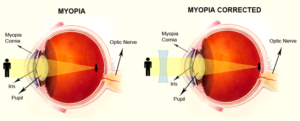
Others have hypothesized that our concerns stem from an infectious component not yet identified.  However, new research asserts it rises from our behavior.  As technology has changed, our behaviors have changed.  We are spending increasing amounts of time indoors reading and watching screens.  In the past, many have asserted that poor eyesight is a common predictor of intelligence, citing eye strain related to reading or screen-time as a major predictor for nearsightedness.  However, nearsightedness may not be related to eye strain but, instead, the increased time we are spending inside (Marczyk, 2017).  When examining children who spend most of their time indoors, researchers found they had a greater likelihood of developing myopia, or nearsightedness, than their peers who spent more time outside.   In healthy eyes, light focuses on the back of the retina (National Eye Institute, 2017).  In eyes with myopia, the light is focused before it hits the retina resulting in a blurry image.


The new hypothesis suggests limited exposure to sunlight during development results in more difficulties with nearsightedness as the eye never learns to adapt to high exposure to light (Marczyk, 2017).


References
Marczyk, J. (2017). Why do so many humans need glasses?: Mismatched modern and ancestral environments, and their consequences. Psychology Today. Retrieved from https://www.psychologytoday.com/blog/pop-psych/201706/why-do-so-many-humans-need-glasses

National Eye Institute. (2017). Facts about myopia. Retrieved from https://nei.nih.gov/health/errors/myopia


Michael Daniel, MA, LPA (temp)
WKPIC Doctoral Intern


Friday Factoids: Why Am I So Thirsty?


New research has begun examining how we know when to stop drinking.  It may come as a surprise, but we stop drinking well before our body has begun processing the liquids we have ingested (Hamilton, 2018).  Past research discovered the “thirst center” of the brain would trigger the body to quit drinking when it recognized enough liquids were taken in, however, there was little understanding as to how it worked.


Now, researches have learned that nitric oxide synthase-expressing neurons in the median preoptic (MnPO) nucleus alert the subfornical organ (SFO) (the part of the brain responsible for thirst) when we are thirsty (Augustine et al., 2018).  When we drink something, MnPO expressing glucagon-like peptide 1 receptors (GLP1R) are activated and inhibit the SFO neurons.  What is interesting is the body recognizes the difference between solids and liquids (Hamilton, 2018).  When ingesting a solid comprised mostly of liquid components (like gelatins), our body does not recognize it as a liquid and inhibit the SFO.


Even more useful, this research helps better explain psychogenic polydipsia, a disorder in which people are unable to recognize when they have had enough to drink (Hamilton, 2018).  This disorder can commonly lead people who have suffered brain trauma to drink dangerous amounts of water or other liquids believing they are still thirsty.  After inhibiting GLP1R-expressing MnPO in mice, the study found similar effects, suggesting this area of the brain is a major contributor to the expression of psychogenic polydipsia (Augustine et al., 2018).


References:
Augustine, V., Gokce, S. K., Lee, S., Wang, B., Davidson, T. J., Reimann, F., . . . Oka, Y. (2018). Hierarchical neural architecture underlying thirst regulation. Nature. doi:10.1038/nature25488


Hamilton, J. (2018). Still thirsty? It’s up to your brain, not your body. NPR. Retrieved from https://www.npr.org/sections/thesalt/2018/02/28/589295404/still-thirsty-its-up-to-your-brain-not-your-body


Michael Daniel, MA, LPA (temp)
WKPIC Doctoral Intern


Friday Factoids: Psychological Preparation for the Olympics

With the 2018 Winter Olympics coming to a close in the next few days, you may be wondering how these word class athletes handle the stress of performing on an international level.  These athletes do not just have to be in the best physical shape of their lives, but they also have to be mentally prepared.


And that is where psychologists can help.  Jim Taylor, Ph.D. has been working with athletes to create an individualized program to allow each of them to perform to the best of their abilities (February 2018).  He noted that the technique most commonly used with his athletes is mental imagery and described several benefits of this technique. First, mental imagery allows athletes to imagine feeling great during the event, which helps to boost their overall confidence level before they compete.  Second, it allows the athlete to focus on what they need to do to perform their best.


So, the next time you are stressed about an upcoming event, channel your inner Olympic athlete and form a mental image yourself “winning gold.”


References
Taylor, J. (2018, February 5). Mentally Preparing for Olympic Sports Success. Retrieved from https://www.psychologytoday.com/blog/the-power-prime/201802/mentally-preparing-olympic-sports-success


Anissa Pugh, MA, LPA
WKPIC Doctoral Intern


Article Review: De Sio, S., et al: Quality of life in workers and stress: Gender differences in exposure to psychosocial Risks and perceived well-Being


Oftentimes, work can be stressful. Between deadlines, the phone ringing off the hook, and the stack of requests building up in the corner, the daily grind can become frustrating. However, that frustration is not always the same for everyone. De Sio et al. (2017) completed a study examining the stress levels of people in the workplace and later decided to take the research a step further and examine gender differences in relation to stress. As it turns out, female employees frequently experience more stress than their male peers.


The study utilized the two scales to assess levels of stress. The Health and Safety Executive Indicator Tool (HSE-IT) examines 6 components of the workplace: demands placed on the employee, their perception of control in the workplace, their perceived feeling of support from employers, the quality of peer relationships, their understanding of their role, and how change is communicated to employees. The second screener, the WHO-5, examined feelings of satisfaction in life and the workplace through 5 brief questions. On both tests, the study found female employees consistently demonstrated lower workplace satisfaction when compared to their male peers. Most notably, female employees reported increased concerns in the Relationship domain on the HSE-IT, suggesting they felt poor peer interactions impacted their work experience. Questions in the Relationship domain examine workplace harassment and “friction” between employees, suggesting women are more subject to harassing comments that cause undue stress at work. Female employees also noted difficulties with Demand and Support from Managers. These concerns demonstrate that women employees report additional expectations being placed upon them by employers. However, these same employers are not providing them the same support they provide their male colleagues, creating a dynamic that is not inclusive to female employees and produces excess stress.


While the study does a good job of examining workplace dynamics and the gender differences related to stress, additional research would be useful to improve the current findings. Notably, the study was conducted in Italy, and while the results are beneficial the United States, it would be helpful to replicate the study in US workplaces to determine if the discrepancy in stress is similar or different to the Italian study. It would also be helpful to conduct the study in additional workplaces. The current study was conducted in a factory setting, and it would help to incorporate research in other settings to determine if there were differences among them. Overall, the study is very beneficial in helping illustrate the discrepancies in how male and female employees experience the workplace and creates a lot of room for discussion in how we can improve the workplace and make it feel safer and more accommodating.


References:
De Sio, S., Cedrone, F., Sanità, D., Ricci, P., Corbosiero, P., Di Traglia, M., & … Stansfeld, S. (2017). Quality of life in workers and stress: Gender differences in exposure to psychosocial Risks and perceived well-Being. Biomed Research International, 1-6. doi:10.1155/2017/7340781


Michael Daniel, MA, LPA (temp)
WKPIC Doctoral Intern