
Friday Factoid Catch-Up: Toward Cultural Competence: Historical/Generational Trauma Related to Japanese Americans


Historical trauma is relevant to examine regarding the Japanese population in the United States, because those who never experienced the traumatic stressor themselves, such as children and descendants, can still exhibit signs and symptoms of trauma. “During World War II, the United States confined 120,000 Japanese Americans in camps based solely on their Japanese heritage and two thirds of those forced to live in the camps were United States Citizens,” (Nagata, Kim, & Nguyen, 2015.) In addition, the researchers noted that even though the United States was also at war with Germany and Italy, neither German Americans nor Italian Americans were subjected to mass incarceration, like the Japanese Americans.


When conducting psychological treatment with this population it is important to be mindful of the historical and generational trauma Japanese individuals have faced, and to note that, “Even though the incarceration assaults on identity represented a cultural trauma, Japanese Americans did not process them as a collective group. Instead, the impacts were contained primarily at the individual trauma level, during and after the war,” (Nagata, Kim, & Nguyen, 2015.) In addition, the researchers stated, after the Japanese Americans experienced incarceration in camps, they attempted to cope by silence to repress the incarceration trauma for more than three decades. Laub and Auerhahn (1984) supported Nagata, Kim, and Nguyen (2015) and stated, “The more profound the outer silence exhibited by a Japanese individual, the more extensive was the inner impact of the event experienced (p. 154).”


In many cases, the lack of communication about the interment created a sense of foreboding for the Sansei as they grew older, and ultimately increased the curiosity about the camps, as well as heightened their sense of parental trauma (Nagata, 1991). A participant described the topic of internment as a forbidden topic that family tiptoed around, like a family scandal. It is important when conducting therapy with Japanese individuals to explore the role of this silence, not only on an individual level but a familial level, and to explore the client’s interpretation of that silence. In addition, this population may experience lower levels of self-esteem and identity issues stemming from the historical trauma, which may need to be considered in current psychological treatment. According to Nagata (1991), after the camps, many Nisei felt particularly pressured to demonstrate their worth after being rejected by their country, and their Sansei children were also expected to be the best and acquire the respect of others. Further, while Sansei today have more opportunities accessible to them than their Nisei parents, the camp experience of their parents may continue to affect their sense of ethnic identity, resulting in issues of identity.


Narrative Therapy may be beneficial when working with this population because it will allow the therapist to evaluate the stories of the client and can serve several functions in clinical practice: (1) to “make the latent manifest,” (2) to “help construct a unifying narrative, “and (3) to “reconstruct a more useful and coherent interpretation of past events and future projects than the client’s present narrative” (Polkinghorne, 1988, p. 178). Family therapy is also advantageous for this population because, “The focus of the family work is to unburden relationships by encouraging dialogues among family members whereby protected, hidden, and even unconscious conflicts of loyalty, obligations, myths, and legends can surface and be examined” (Miyoshi, 1980, p. 41).


References
Laub, D. & Auerhahn, N.C. (1984). Reverberations of genocide: Its expression in the        consciousness and unconsciousness of post-Holocaust generations. In S. A. Lueland P. Marcus (eds.), Psychoanalytic reflections on the Holocaust (pp. 151-167).   New York: KTAV Publishing House.

Miyoshi, N. (1980). Identity crisis of the Sansei and the American concentration camp.     Pacific Citizen, December 19-26, 91, pp. 41-42, 50, 55.

Nagata, D. K. (1991). Transgenerational Impact of The Japanese- American Internment:   Clinical Issues in Working With Children of Former     Internees. Psychotherapy28(1), 121-128.

Nagata, D. K., Kim, J. J., & Nguyen, T. U. (2015). Processing Cultural Trauma:    Intergenerational Effects of the Japanese American Incarceration. Journal Of      Social Issues71(2), 356-370. doi:10.1111/josi.12115

Polkinghorne, D. E.  (1988). Narrative knowing and the human sciences. New York:         State University of New York Press.


Katy Roth, M.A., CRC
WKPIC Doctoral Intern



Article Review–Mindfulness Groups for Psychosis: Key Issues for Implementation on an Inpatient Unit (Jacobsen, Morris, & Johns, 2010)


In the last 40 years, there has been an increased interest and usage of mindfulness based therapy approaches to treat a variety of mental disorders.  Mindfulness activities teach the individual to be aware of the experience by purposefully paying attention to the present moment in a non-judgmental way (Kabat-Zinn & Hahn, 1990).  Some of the most common therapeutic approaches that utilize mindfulness activities are Mindfulness Based Stress Reduction, Mindfulness Based Cognitive Therapy, Acceptance and Commitment Therapy, and Dialectical Behavior Therapy.


Emerging research now indicates that mindfulness based therapy may be a beneficial treatment approach for psychosis.  Jacobsen, Morris and Johns (2010) studied the feasibility of using mindfulness based therapy groups on an inpatient unit.  All participants in this study were currently on an inpatient unit that specializes in working with individuals with severe psychosis.  Eight patients completed the study and the average length of contact with mental health services for these patients was 12 years (Jacobsen, et al., 2010).
 

In the study, group sessions met for a one hour session over the course of 6 weeks.  Group session format was consistent across all sessions to provide familiarity and to accommodate those who were unable to attend all sessions (Jacobsen, et al., 2010).   Each session included a two 10-minute mindfulness breathing exercises followed by group discussion based on protocols used by Chadwick and colleagues (2005).  Discussions included the rationale for mindfulness therapy, how mindfulness can be utilized in distressing situations, and recent experiences with mindfulness.


The results of this study indicated that mindfulness based therapy groups are a feasible treatment option for individuals with psychosis who are currently at an inpatient hospital.  Specifically, the study found individuals with psychosis do well in short sessions where they can reflect on personal experiences (Jacobsen, et al., 2010).  The study noted that for a group to be successful on an inpatient unit is to ensure all members of the interdisciplinary team have an understanding of the skills to help promote patient participation outside of the group setting.


References

Chadwick, P., Newma-Taylor, K., & Abba, N. (2005). Mindfulness Groups for People with Psychosis. Behavioural and Cognitive Psychotherapy33, 351-359.


Jacobsen, P., Morris, E., Johns, L., & Hodkinson, K. (2010). Mindfulness Groups for Psychosis; Key Issues for Implementation on an Inpatient Unit. Behavioural and Cognitive Psychotherapy39, 349-353.


Kabat-Zinn, J., & Hanh, T. N. (1990). Full catastrophe living: Using the wisdom of your body and mind to face stress, pain, and illness. Delta.


Anissa Pugh, MA, LPA
WKPIC Doctoral Intern


Article Review: From Traditional Inpatient to Trauma-Informed Treatment: Transferring Control from Staff to Patient (Chandler, 2008)

At least 85% of mental health consumers report exposure to trauma at some point in their lives. A vast majority of these consumers lack the appropriate coping skills to manage their emotions and reactions appropriately, traditionally resulting in the use of restraints, isolation or coercion when in an inpatient setting. The shift to trauma-informed care requires staff working with these patients to understand that the individual is doing the best they can, with the coping skills they have based on their life experiences. Trauma-informed care involves including consumers in their treatment and allowing them to have a voice in what they feel would be of most benefit. Below are some basic ways to create a trauma-informed treatment environment in an inpatient setting:


  • Provide education and skills training to help consumers better understand their diagnosis and present them with opportunities to both develop and practice new coping skills


  • Emphasize individual choice and allow the consumer to be an active participant in their treatment and treatment decisions


  • Focus on interventions that are strength based and culturally sensitive


  • Work to reduce re-traumatization by educating staff on the effects of trauma


  • Share information with consumers, starting at admission, to help them understand the process and encourage them to actively participate in their treatment


  • Allow patients to use one another as a resource


  • Encourage staff to focus on building relationships with consumers and promote connectedness with others


  • Provide consumers with choices in regards to their care and what they feel will be the most effective approach


  • Create and implement safety protocols from admission to discharge


Chandler, G. (2008). From Traditional Inpatient to Trauma-Informed Treatment: Transferring Control From Staff to Patient. Journal of the American Psychiatric Nurses Association, 14(5), 363-371. doi:10.1177/1078390308326625


Crystal Henson, MA
Doctoral Intern


Friday Factoids: I Can't See Without My Glasses!

It’s become increasingly common for people to need glasses to improve their vision (Marczyk, 2017).  For many, this increasing issue has been puzzling since, years prior to the advent of glasses, people were able to survive without corrected vision.  Many theories have been examined.  Some have asserted that, with corrective lenses, bad vision is no longer a hindrance to survival and no longer a deterrent evolutionarily (Marczyk, 2017).


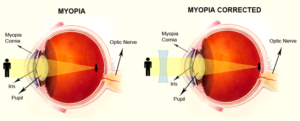
Others have hypothesized that our concerns stem from an infectious component not yet identified.  However, new research asserts it rises from our behavior.  As technology has changed, our behaviors have changed.  We are spending increasing amounts of time indoors reading and watching screens.  In the past, many have asserted that poor eyesight is a common predictor of intelligence, citing eye strain related to reading or screen-time as a major predictor for nearsightedness.  However, nearsightedness may not be related to eye strain but, instead, the increased time we are spending inside (Marczyk, 2017).  When examining children who spend most of their time indoors, researchers found they had a greater likelihood of developing myopia, or nearsightedness, than their peers who spent more time outside.   In healthy eyes, light focuses on the back of the retina (National Eye Institute, 2017).  In eyes with myopia, the light is focused before it hits the retina resulting in a blurry image.


The new hypothesis suggests limited exposure to sunlight during development results in more difficulties with nearsightedness as the eye never learns to adapt to high exposure to light (Marczyk, 2017).


References
Marczyk, J. (2017). Why do so many humans need glasses?: Mismatched modern and ancestral environments, and their consequences. Psychology Today. Retrieved from https://www.psychologytoday.com/blog/pop-psych/201706/why-do-so-many-humans-need-glasses

National Eye Institute. (2017). Facts about myopia. Retrieved from https://nei.nih.gov/health/errors/myopia


Michael Daniel, MA, LPA (temp)
WKPIC Doctoral Intern


Friday Factoids: Why Am I So Thirsty?


New research has begun examining how we know when to stop drinking.  It may come as a surprise, but we stop drinking well before our body has begun processing the liquids we have ingested (Hamilton, 2018).  Past research discovered the “thirst center” of the brain would trigger the body to quit drinking when it recognized enough liquids were taken in, however, there was little understanding as to how it worked.


Now, researches have learned that nitric oxide synthase-expressing neurons in the median preoptic (MnPO) nucleus alert the subfornical organ (SFO) (the part of the brain responsible for thirst) when we are thirsty (Augustine et al., 2018).  When we drink something, MnPO expressing glucagon-like peptide 1 receptors (GLP1R) are activated and inhibit the SFO neurons.  What is interesting is the body recognizes the difference between solids and liquids (Hamilton, 2018).  When ingesting a solid comprised mostly of liquid components (like gelatins), our body does not recognize it as a liquid and inhibit the SFO.


Even more useful, this research helps better explain psychogenic polydipsia, a disorder in which people are unable to recognize when they have had enough to drink (Hamilton, 2018).  This disorder can commonly lead people who have suffered brain trauma to drink dangerous amounts of water or other liquids believing they are still thirsty.  After inhibiting GLP1R-expressing MnPO in mice, the study found similar effects, suggesting this area of the brain is a major contributor to the expression of psychogenic polydipsia (Augustine et al., 2018).


References:
Augustine, V., Gokce, S. K., Lee, S., Wang, B., Davidson, T. J., Reimann, F., . . . Oka, Y. (2018). Hierarchical neural architecture underlying thirst regulation. Nature. doi:10.1038/nature25488


Hamilton, J. (2018). Still thirsty? It’s up to your brain, not your body. NPR. Retrieved from https://www.npr.org/sections/thesalt/2018/02/28/589295404/still-thirsty-its-up-to-your-brain-not-your-body


Michael Daniel, MA, LPA (temp)
WKPIC Doctoral Intern