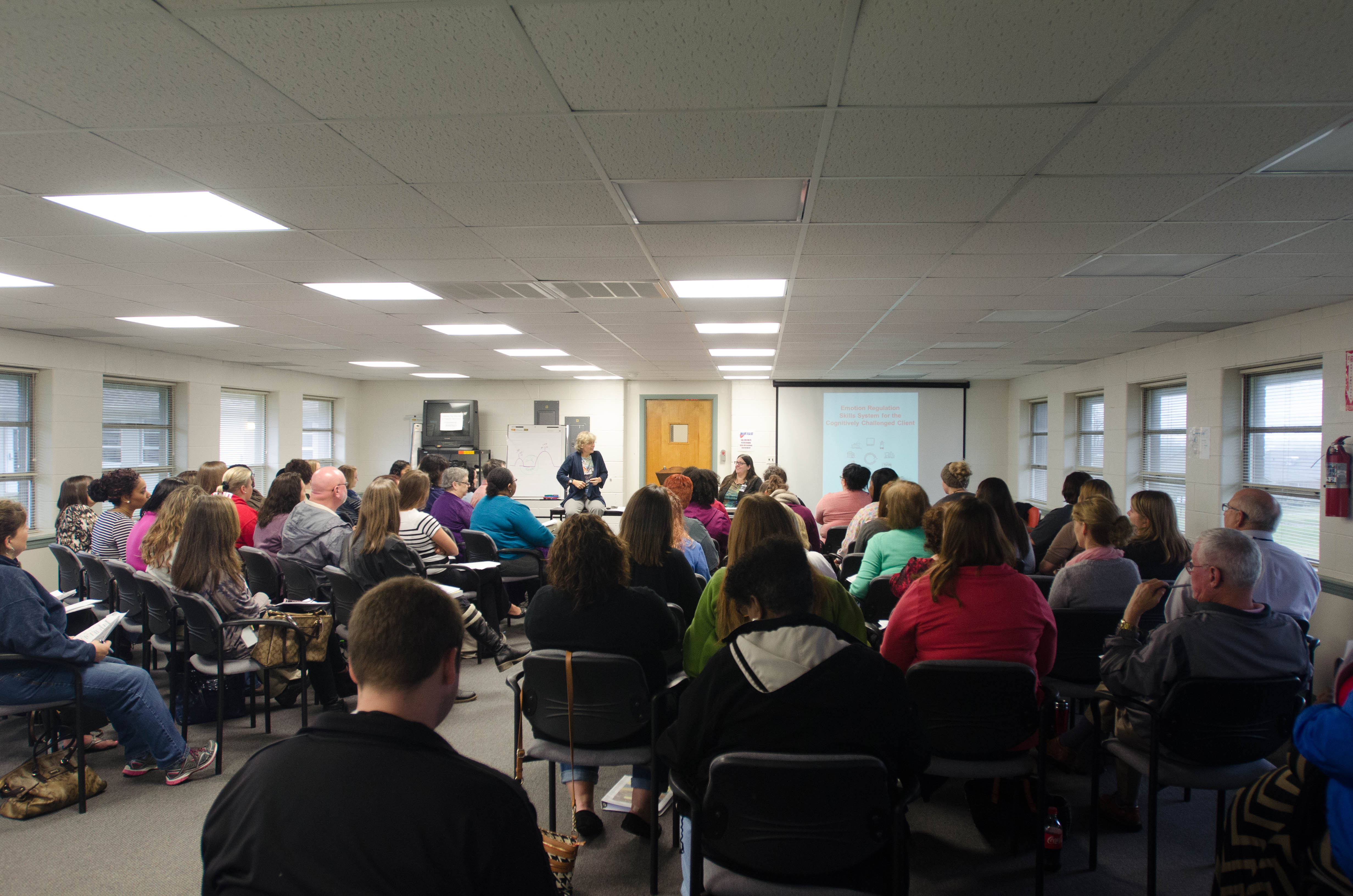
Skills System Training!

20151028-DSC_1457

What do you do when you have patients who could really benefit from Dialectical Behavioral Therapy, but they can’t read, or have much lower intellectual capacity and can’t learn some of the bigger words and concepts, or have interference and challenges like active psychosis?


20151028-DSC_1460


You call Dr. Julie Brown and learn about The Skills System—-“an emotion regulation system for ALL learning abilities!


We can attest that the principles are simple, straightforward, easy to learn, and applicable 20151028-DSC_1463even for people with moderate intellectual disability. Dr. Brown was kind enough to pay Western State Hospital and WKPIC a visit, and to train psychology, social work, therapeutic recreation, Recovery Services, and all levels of nursing staff for an entire day.


We hope to use The Skills System to benefit patients with multiple hospitalizations due to emotional regulation issues related to chronic mental illness.

Friday Factoids: Challenges in Serving Rural Areas

Mental health disorders cause more disability and suffering in rural areas of our country. The presence of high rates of depression, domestic violence and child abuse creates increased risk for behavioral health issues. In addition, rural areas have higher rates of abuse of alcohol, tobacco, opiates, meth, inhalants, marijuana and cocaine. Suicide attempts and deaths by suicide occur more often in rural settings, with the rate of deaths by suicide running as much as 300% higher than an equivalent urban sample in some areas. Reasons for these disparities are certainly complex, but can be summarized under three primary categories: accessibility of mental health treatment, availability of services, and the acceptability of receiving services in rural culture.


Accessibility to services is a complex problem that rural health providers are attempting to address. Rural residents are likely to live further apart from one another, further away from services, and have less access to transportation. Telehealth is one recent technique being used to address some of these issues but it must be considered that due to the higher poverty levels in rural areas, some people may not have access to the technology required to receive telehealth in their home. The prevalent rates of domestic violence could provide a significant barrier for the use of telehealth in such situations. Many community mental health agencies provide i- school services in order to overcome some accessibility problems. Additionally, some rural mental health centers are creating “hubs” for telehealth services, but continue to struggle with transportation to get patients in need to these hubs for sessions.


The availability of services is limited in rural areas. A major problem in service provision is a relatively low number of doctoral level psychologists, coupled with high turn-over rates for any degreed professional attempting to practice in rural areas. Structured treatment locations are even more limited. Treatment centers for substance abuse or inpatient mental health can frequently be 1-4 hour commutes each way, and the lack of the availability of services closer to home may create an unbearable financial hardship due to time away from work, transportation costs, and childcare. Additionally, rural residents may have been aware of their behavioral health difficulties but unable or unwilling to access far away services until a crisis has occurred. This same pattern exists in accessing medical services as well, but less stigma is present in seeking medical versus psychological help. As such, treatment facilities that have a rural catchment area tend to have higher levels of acuity than urban centers, and thus face working with more urgent and challenging patients and conditions with minimal resources.


Finally, as mentioned, there is a lower rate of acceptability of mental health services by many rural people. While there have been recent gains made in decreasing mental health stigma, rural areas lag behind urban environments in understanding and accepting mental health issues.


A potential solution to some of these troubling difficulties may be integrated health clinics. Since medical services are more socially acceptable to rural residents, why not address accessibility and stigma by providing medical and mental health services under one roof? This lessens the patient’s anxiety about being identified by others within their community as receiving mental health services. Also, since medical and mental health issues interact and tend to exacerbate one another, approaching patients more holistically may serve to decrease both mental health and medical crises, and reduce overall acuity levels.


An additional hurdle is that many clinicians lack training in rural cultural competencies. Creative ways of working in rural communities are needed at graduate, practicum, and internship levels—and solutions may vary from community to community, needing specific approaches. Community mental health models that work well in urban environments may not be feasible in rural areas, so clinicians need to take a “troubleshooting” approach in the rural area they wish to serve.


Solutions to the barriers to mental health care in rural areas can be identified and developed. Most importantly, all mental health services need to be tailored to the culture and way of life of the rural area being served.


References
Smalley, K. B., Rainer, J., & Warren, J. (2012). Rural Mental Health : Issues, Policies, and Best Practices. New York: Springer Publishing Company


Rain Blohm, MS
WKPIC Doctoral Intern


Friday Factoids: The Search for Causation of Autism Spectrum Disorder


With the diagnosis of Autism Spectrum Disorder (ASD) on the rise, professionals and parents from all walks of life have been increasingly steadfast and diligent in their research and support for families and people contending with these issues. One of their goals is to find a suitable treatment for the millions who currently experience difficulties, that would greatly reduce or permanently eliminate symptoms of the often debilitating disorder. Another main focus for many is the development of preventative guidelines or an inoculation that would drastically reduce the number of sufferers who develop ASD.


To achieve any of these goals, it is imperative that we understand the root cause(s) of ASD. Scientist and medical professionals have been testing hypothesis after hypothesis but have yet to discover the origin of the disorder. Medical Science and families were hopeful when the announcement was made that the prevalence of ASD in the Amish Community was 0%. Unfortunately, we now know this information is inaccurate, but not all hope has been lost. Research data obtained from 1899 Amish children ages 3-21 years was collected. The results proved that the disease does in fact exist in the Amish population at the rate of approximately 1 in 271 children. This is a significantly reduced rate when associated with the national average of 1 in 68 children today in the U.S. It’s a comparison of .0037% to .0147% but what does that mean for explorations of causation?


Research into how Amish Communities differ from everyday society is currently being conducted. The lack of radiation, radio waves, and gamma waves is being considered, as well as a comparison of the amount of artificial ingredients, preservatives and hormones added to the processed, manufactured foods ingested by most Americans. Another area being looked at is the number of chemicals we are subjected to through use of common household products including shampoos, household cleaners and pesticides. Since the Amish have no religious objections to vaccines, with many getting them as recommended by the CDC guidelines, inoculations can be ruled out. Future research should test for ASD in remote populations. A comparison can then be made with the percentage of incidence with the data obtained from the Amish Community in hopes of finding a correlation or pattern.


Reference
Reynolds, A. (n.d.). Combating Autism from Within: Guess what? The Amish vaccinate! Retrieved September 20, 2015, from http://combatingautismfromwithin.blogspot.com/2008/01/guess-what-amish-vaccinate.html


Robinson, J., Nations, L., Suslowitz, N., Curraco, M., Haines, J., & Vance, M. (2010, May 22). Prevalence Rates of Autism Spectrum Disorders Among the Old Order Amish. Lecture presented at International Meeting for Autism Reseach in Franklin Hall B Level 4 (Philadelphia Marriott Downtown, Philadelphia, PA.


Crystal K. Bray, BS
WKPIC Doctoral Intern

Friday Factoids (Catch-Up): Special K–Are There Any Positives?


It was not the beginning of the zombie apocalypse that we were witnessing on the news a couple of years ago. Believe it or not, it was worse. Apparently, possible consumption of human flesh is one of the many unwanted side effects of abusing the anesthetic, Ketamine. “Special K”, as it is known on the streets, underwent a transformation into the new party drug, and it has been taking its place alongside opiates, benzodiazepines, and marijuana with teens and twenty-somethings since about 2010. Since that time, this once surgically “essential” and publically unknown drug has been drawing vast amounts of negative media, criminal and medical attention—but are there any positives associated with this drug?


Recently, scientists, mental health and medical professionals have discovered that medically controlled doses of Ketamine are very beneficial in treating Major Depressive Disorder and Bipolar Disorder. Yes, the same medication approved as an anesthetic in 1970, the same drug that has been abused to get high since the 2010’s, is providing evidence-based results that it does, in fact, reduce depression and regulate mood. Studies have shown that it produces significant results within a matter of minutes to hours instead of 2-3 weeks, which is the window within which standard pharmacological treatments for mood typically show benefits. Additionally, patients suffering from suicidal ideation who were treated with a “medically controlled dose” of Ketamine (medically controlled dose being key) reported their symptoms drastically reduced in 40 minutes, with gains lasting about 4 hours. Clinics around the U.S. are even currently treating patients suffering from depression and mood disorders using controlled amounts of Ketamine (yes, this is legal).


So Ketamine does appear to have some positives with respect to potential uses in the treatment of both unipolar and bipolar mood issues. It potentially provides treatment results, time frames and options for practitioners and patients, but the key appears to be the controlled dosing.


Reference
DiazGranados, N., Ibrahim, L., Brutsche, N., Ameli, R., Henter, I., Luckenbaugh, D., . . . Zarate, JR, C. (n.d.). Rapid Resolution of Suicidal Ideation after a Single Infusion of an NMDA Antagonist in Patients with Treatment-Resistant Major Depressive Disorder. J Clin Psychiatry., 71(12), 1605-1611. Retrieved September 7, 2015, from https://nebula.wsimg.com/5f3b6cc5e31881bab9f0fb5d070d35d2?AccessKeyId=98358B1A7BDF604FD210&disposition=0&alloworigin=1


Ketamine Facts, Effects and Treatment | Ketamine Clinics – Los Angeles, CA. (n.d.). Retrieved September 9, 2015.


Crystal K. Bray, BS
WKPIC Doctoral Intern


Friday Factoids: Abandonment

Research has shown that therapists view termination as a complex stage of psychotherapy (Gelso & Woodhouse, 2002, as cited in Hardy & Woodhouse, 2006), though client responses are variable.


As cited by Hardy and Woodhouse (2006) clients often report positive feelings regarding termination, to include:  pride, health, a sense of accomplishment, independence, cooperative, calmness, alive, agreeable, friendly, good, healthy, thoughtful, and satisfied.  Interestingly, Hunsely, Aubry, Verstervelt, and Vito (1999) reported that 38.6% of clients attributed termination as a successful achievement of goals.  Thus, Hardy and Woodhouse (2006) note that therapists may underestimate client perception of growth.


It is important that therapists become aware of these positive reactions, as psychotherapists may attribute more negative emotional reactions to termination.  Additionally, understanding the difference between termination and abandonment is essential to ethical practice.  Termination is a clinical decision based on competent practice.  Per the ethics code, termination becomes clear when the client no longer needs services, is not likely to benefit, or is being harmed by continued service (American Psychological Association [APA], 2010).  The latter may occur when a psychologist is not working within his or her boundaries of competence.  Abandonment is an inappropriate termination (Behnke, 2009).  Again, sound clinical thinking and consultation/supervision may help guide the decision process to ensure ethical termination. Yet, unfortunately termination can be more abrupt, such as in forced termination for interns (end of rotation)?


Often with forced termination, the goals of therapy have not been met and the provider may not handle the termination in an appropriate manner.  Such may be due to lack of training.  For instance, Zuckerman and Mitchell (2004) found that pre-doctoral interns reported they felt less than adequately prepared for forced termination.  Thus, Hardy and Woodhouse (2006) highlight the need for focused training, specific to forced termination.  According to the ethics code, pre-termination counseling is recommended (APA, 2010).  With forced termination, often the end of services is known, therefore one should be proactive and notify the client in an appropriate manner.   In other words, with termination, preparation of the client is necessary.  When it is appropriate and after sound clinical decision-making and supervision, all efforts should be made to ensure an ethical termination and transfer to another provider occurs.  Taking such care will help minimize harm and promote ethical practice.


References
American Psychological Association. (2010). Ethical Principles of Psychologists and Code of Conduct. Retrieved from http://www.apa.org/ethics/code/


Behnke, S. (2009). Termination and abandonment: A key ethical decision. Retrieved from http://www.apa.org/monitor/2009/09/ethics.aspx


Hardy, J. A. & Woodhouse, S. S. (2008, April). How We Say Goodbye: Research on Psychotherapy Termination. Retrieved from http://societyforpsychotherapy.org/say-goodbye-research-psychotherapy-termination


Hunsley, J., Aubry, T. D., Verstervelt, C. M., & Vito, D. (1999). Comparing therapist and client perspectives on reasons for psychotherapy termination. Psychotherapy, 36, 380-388.


Zuckerman, A., & Mitchell, C. L. (2004). Psychology interns’ perspectives on the forced termination of psychotherapy. The Clinical Supervisor, 23, 55-70.


Dannie S. Harris, M.A., M.A., M.A.Ed., Ed.S.
WKPIC Practicum Trainee