In a time where social media has us collecting people as “friends” or “followers,” one wonders how many of these relationships are real and, perhaps more importantly, how many of these bonds are strong enough to really be considered relationships? There has been some debate about how strong these ties need to be in order to consider people as close to you.
Robin Dunbar suggests that most people have around 150 stable relationships, this has become known as “Dunbar’s Number.” A stable relationship in this sense is described as knowing who the person is and how he/she relates to others in the group of stable relationships. So, I’ll issue an apology to those individuals with thousands of friends or followers before I say: “I don’t think so!”
You made it through your graduate coursework. You’re facing down that dissertation like a wild animal trainer, grim-faced, ready for combat. These are just application essays. No need to panic.
I know, I know. Every one of your fellow students has an opinion. All of your professors and supervisors give you different advice. You’ve revised your essays howmany times now? I get it. So, I’m going to give you my opinion, as someone who reads a lot of these every single year, and uses them to help decide which candidates we’re interviewing at WKPIC, and which we’re giving a pass this year.
I can only speak for our tiny corner of the APPIC Match world, but as WKPIC’s Training Director, here’s what I want to see in your essays:
You.
This is my only chance to meet you on paper, other than a bunch of numbers and labels and statistics. Show me who you are as a professional and a person, so I’ll know if we can work with you. Are you smart? Let yourself shine. Are you funny? Use a bit of humor. Do you love to learn? Let me feel the energy. Basically, your essays can leave you in neutral, or push you into I’ve-got-to-meet-this-student.
And now for the details.
Do you really read the essays? Yes. Every . . . freakin’ . . . one. Even when I’ve got a stack of fifty applications, and get another stack that big the very next week. The other internship faculty members do, too. Making a match with our setting is very, very important to us, and this is a huge tool in initial screening, in our opinion. Plus, I may have gone on internship in the Paleolithic Period, but Match existed, and I remember pouring my heart, soul, and future into every word I wrote. I’m assuming you did, too, and I plan to respect that. Last year, I even built a desk shelf onto my treadmill so I could read while I walked. I read in meetings between speakers. I read on breaks. I read on vacation days. If you write it and apply to us, we will know what you said. We’ll be reading those essays.
Does grammar and spelling matter to you at WKPIC? To put it simply, YES. Our internship involves a lot of writing–initial assessments, evaluations, therapy notes, emails, and more. If I see I’m going to have to work multiple hours proofreading or revising whatever you do just to bring the basic grammar and spelling to standard, consider me scared, and likely scared enough not to interview you. That being said, if you end up with a couple of typos in your entire gigantic application, don’t panic. You’ll probably find a few typos in my posts on this blog. You may find a few typos in books I’ve published. I even found one in Harry Potter and the Prisoner of Azkaban (no, not lying! Somewhere around page 280-300, Snape is called Snap. Oh, Snap!). Typos happen. Just do your best, and show me that you have a reasonable command of the language.
Should I be super-specific and adamant about my theoretical orientation? Um, no. Not for us. Even if you are, we won’t totally believe you. I mean, we know you’re not kidding or anything, it’s just that except in rare circumstances, theoretical orientation prior to internship and your first few years of practice can be a bit shaky. Tell us what you’ve done the most, what you feel the most comfortable doing, and where you think you’re headed/want to head with theoretical orientation. That’s enough for us. We’ll be happy to work with you in that direction, and see how it pans out for you as you contend with it across multiple functional levels and disorders.
Is creative good, or should I play it completely safe? Remember, I am answering only for myself, and in general what we at WKPIC look for–but I like to see at least one creative or a bit less “in the box” essay. Again, what I like to see is YOU. Without at least a dash of intellectual pizzazz, I won’t know you’ve got that spark. You have to show me. I like seeing a couple of straightforward, professionally done pieces, and if they are all that way, that’s okay. If one steps a little away from “safe,” you definitely don’t lose my interest.
The bottom line is–you can do this. You can write those essays, and we’ll read them. They will matter.
Greenberger and Padesky (1995) explain in their book, Mind Over Mood: Change How You Feel by Changing the Way You Think, that our expectations affect our behavior. People are more likely to try to do something and succeed if they believe it is possible.
For many years, athletes believed that it was absolutely impossible for a human to run a 4-minute mile. In track events all around the world, top athletes ran a mile in just over 4 minutes. Then a man named Roger Bannister, a British miler, decided to determine what changes he could make in his running style and strategy in order for him to break the 4-minute barrier. Bannister believed it was possible to run faster and put many months of effort into altering his running pattern to reach this particular goal. In 1954 Roger Bannister became the very first man to run a mile in less than 4 minutes. It was his belief that he could succeed that contributed to the change in the behavior. Remarkably, once Bannister broke the record, the best milers from all around the world also began to run the mile in under 4 minutes. Unlike Bannister, these athletes had not substantially changed their running patterns. The thing that had changed was their thoughts; they now believed it was possible to run this fast and their behavior followed their thoughts.
Just knowing it is possible to run this fast does not mean everyone can do this, of course. Thinking something is not the same thing as doing it. But the more you believe something is possible the more likely you are to attempt it and maybe succeed at it.
Reference: Greenberger, D. & Padesky, C.A. (1995). Mind over mood: Changing how you feel by changing the way you think. New York, NY: The Guilford Press
Pictured from left to right are Cynthia Geil, Cassandra Sturycz, David Wright, and Danielle McNeill.
Cynthia Geil is an intern who hails from the Illinois School of Professional Psychology, Argosy University, in Schaumburg, Illinois. She has experience in substance abuse and chronic mental illness. She has been involved in research related to Reactive Attachment Disorder, and her dissertation explores the connection between religion, life satisfaction, and risky behavior in adolescents.
Cassandra Sturycz is a practicum student from Western Kentucky University.
David Wright is an intern from the American School of Professional Psychology, Argosy University, in Phoenix, Arizona. He has extensive clinical and forensic experience, and he is active duty career military, granted Guard status by the United States Army in order to complete his degree. Mr. Wright has worked over a decade in counterintelligence, and he has received the Military Organization Volunteer Service Medal, the Army Commendation Medal, the Army Achievement Medal, three Good Conduct Medals, and a Defense Meritorious Service Medal.
Danielle McNeill is an intern who comes to us from the Georgia School of Professional Psychology at Argosy University, in Atlanta, Georgia. She has extensive experience in assessment and diagnostics, as well as eating disorders and she has actively participated in the Human Rights Campaign in Alabama and Georgia.
What distinguishes a talker from a great communicator, an effective communicator?
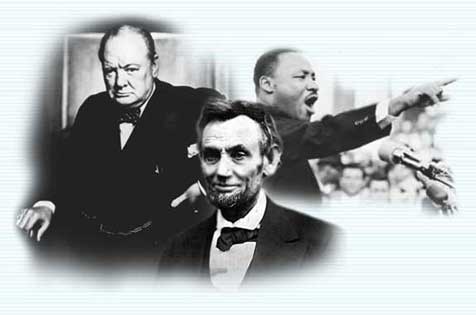
It is the ability to develop a keen external awareness that separates the truly great communicators from those who muddle through their interactions with others. Examine the lives of great leaders like Churchill, King or Roosevelt and you’ll find them all to be exceptional communicators. They might talk about their ideas, but they do so in a way which also speaks to your emotions and your aspirations. They realize if their message doesn’t take deep root with the audience then it likely won’t be understood, much less championed. For tips on effective communication, check out Forbes.com’s take on the communication secrets of great leaders.



 Bannister became the very first man to run a mile in less than 4 minutes. It was his belief that he could succeed that contributed to the change in the behavior. Remarkably, once Bannister broke the record, the best milers from all around the world also began to run the mile in under 4 minutes. Unlike Bannister, these athletes had not substantially changed their running patterns. The thing that had changed was their thoughts; they now believed it was possible to run this fast and their behavior followed their thoughts.